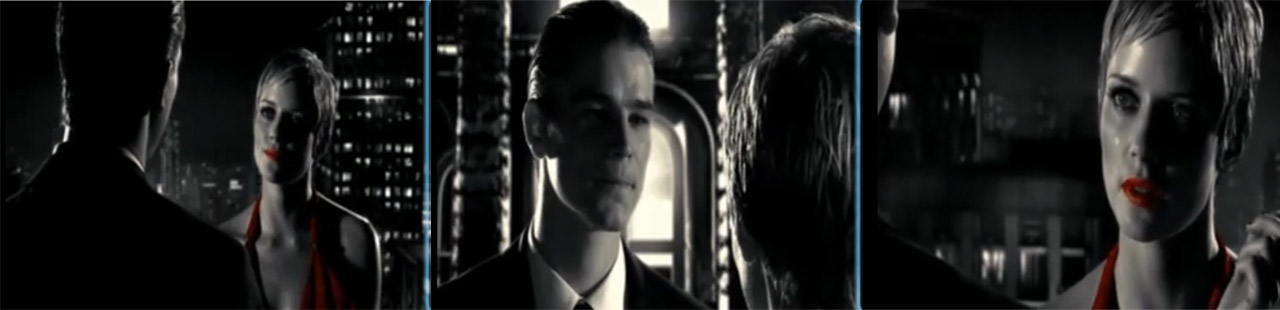
The 180 degree rule is a basic guideline for the on-screen spacial relationship between a character and another character or object in the scene.
Monday, 12 October 2015
Sound Analysis
Diegetic sound :
This is sound in which the source is visible on screen as part of the action.
E.g. Character voices
Non diegetic sound:
This is sound that seemingly does not have a source in the shot being filmed.
Synchronous sound:
This is sound matched to certain movements within the scene. E.g. The sound of footsteps.
Asynchronous sound:
This is sound that are not matched with something visible on screen
Sound effects: Sounds other than speech or music made artificially for use in a film, or other broadcast production.
Sound motif: A sound effect or combination of sound effects that are associated with a particular character, setting, situation or idea through the film.
Sound bridge:
When the scene begins with the carry-over sound from the previous scene before the new sound begins.
Dialogue:
This is a conversation between two or more people in a scene.
Voiceover:
This is where a piece is narrated over by someone who does not appear in the scene.
Mode of address/direct address:
How media speaks to an audience (presentation). This includes first person, third person (narrative) etc.
Direct address is when a character speaks directly into the camera, addressing the audience.
Sound mixing:
The process during post-production in which the collection of recorded sounds are combined into one or more channels along with adjusting the many attributes of the sounds such as the source signals’ level.
Sound perspective:
Sound perspective refers to the apparent distance of a sound. Clues to the distance of the source include the volume of the sound and the balance with other sounds, the frequency range, and the amount of echo and reverberation.
Sound tracks: This is a piece of music that can be attributed to the film.
Score:
This is music specifically written for a film
Incidental music:
This is music used at a particular point in a piece to create a specific atmosphere
Themes and stings:
Music that will always accompany a certain programme or character
Ambient sound: This is the background sounds, e.g. birds singing, wind blowing etc..
Thursday, 8 October 2015
Mise En Scene
Production Design
Production designers are responsible for the visual concept of a film, television or theatre production. They identify a design style while working with the director/producer.
Location/Setting
A filming location is a place where some or all of a film or television series is produced, in addition to or instead of using constructed sets. The setting of a film can also refer to a time period or geographical location for the film.
Studio
A film studio is a privately owned/funded facility that is used to make films, which are often handled by the production company.
Set design
This is the creation of theatrical, as well as film or television scenery that aim to fully immerse the viewer in the production.
Costume and make up
A department that specializes in outfitting characters with outfits and makeup.
Properties (props)
a portable object other than furniture or costumes used on the set of a play or film.
Lighting
Available
Light of almost any sort which exists and has not been introduced to record images. Its use is sometimes fast, cheap, and even beautiful.
Artificial key
The key may determine the character of the lighting. The key should usually be Motivated by a source like the sun or a window.
Fill
Used to lighten shadows and control Contrast and Lighting Ratios.
Back
Back Light separates subject from background, making them "pop out".
Set
The term some Lighting Directors use to refer to Background Light, and others may use instead of "Base Light." Obviously, part of a vast conspiracy to confound beginners .
Practical
A prop light seen in the shot which can be operated by the talent; sometimes doctored to control brightness, color, or coverage.
Colour design
This is the colour scheme used and followed throughout the filming and production of a piece.
Wednesday, 7 October 2015
Editing and Representation
Image and Sound Transition
A transition of sound is generally used to maintain the flow of the film
into the next scene. This is usually done by removing all sound from a
scene, perhaps inserting background music, and then fading in the sound
from the next scene as it appears. An image transition is important in good production. It is the moving
from one scene to another. There are many different ways of carrying
this out, perhaps fading a scene to black and then having the next scene
fade from black. Although there are many different ways to do this and
often more complex transitions are needed at dramatic moments in the
film.
Importance of Editing
Editing is important to ensure clips are pieced together correctly for viewing. It is to allow footage to appear polished rather raw and untouched. Editing is crucial to ensure all key elements are included in the final piece.
Shot/ reverse shot
This is a shot where the camera shows one character looking at another, then flipping to the opposite of the second character looking back at the first.
Here we can see the flipping between each character looking at one another this is to allow the viewer to experience the scene almost from the viewpoint of each character, to really see as they do.
Eyeline Match
An eyeline match is where the viewer is allowed to see what a character is seeing.
Here we can see two scenes where it is showing us the character and then what they see. In film the eyeline match allows the viewer to effectively experience the film through the eyes of their favourite characters. This is allows for a more personal connection to these characters.
Graphic Match
This is a cut in film editing where the two shots or two objects are placed on the screen together to metaphorically link or bind them to one another.
Linking these two objects allows for the viewer to compare them and see the similarities almost creating a mental link between them.
Action Match
A film editing techniques where the editor cuts from one shot to another view that matches the first shot's action.
Jump cut
A cut in film editing where two sequential shots of the same subject are taken from slightly varying angles, giving the effect of a slight jump in time.
Crosscut
A cut that is used in films to establish action occuring at the same time in more than one location. The camera typically cuts between different scenes to suggest a sense of simultaneity.
Cutaway
A film editing cut that interrupts a continuously filmed action by inserting a view of something else. It is usually folowed by a cut back to the first shot .
Insert
A shot filmed from a different angle/focal length from the master shot. Inserts cover action already covered in the master shot, but emphasize a different aspect of that action due to the different framing.
Dissolve
An editing technique which involves a gradual transition from one image to another. The terms fade-in/out are used to describe a transition to and from a blank image.
Cut
In film editing, a cut is an abrupt, but usually trivial film transition from one sequence to another.
Fade-in, Fade-out
Synonymous with a dissolve transition. A fade-in/out involves dissolving from or too a flat colour screen (usually black, grey or white).
Wipe
A type of film editing transition where one shot replaces another by travelling from one side of the frame to another or with a special shape.
Superimposition
In film editing, this is the placement of an image or video on top of an existic image/video, usually to add to the overall image effect, or to conceal soomething.
Long take/short take
A long take is an interrupted shot that lasts much longer than the conventional editing pace either of the film or films in general.
A short take is the opposite, usually much shorter than the conventional take, lasting a few seconds at most.
Slow motion
An effect there time appears to be slowed down. Typically achieved by capturing frames at a rate that is higher than their playback.
Ellipsis & expansion of time
the narrative device of omitting a portion of the sequence of events, allowing the reader to fill in the narrative gaps. The vast majority of films use ellipses to clear actions that add nothing to the narrative.
Post production
Post-production, or postproduction, is part of the process of filmmaking. It is a term for all stages of production occurring after shooting or recording individual program segments.
Visual effects
In filmmaking, visual effects (abbreviated VFX) are the processes by which imagery is created and/or manipulated outside the context of a live shot.