Editing and Representation
Image and Sound Transition
An image transition is important in good production. It is the moving from one scene to another. There are many different ways of carrying this out, perhaps fading a scene to black and then having the next scene fade from black. Although there are many different ways to do this and often more complex transitions are needed at dramatic moments in the film.
Importance of Editing
Editing is important to ensure clips are pieced together correctly for viewing. It is to allow footage to appear polished rather raw and untouched. Editing is crucial to ensure all key elements are included in the final piece.
Shot/ reverse shot
This is a shot where the camera shows one character looking at another, then flipping to the opposite of the second character looking back at the first.
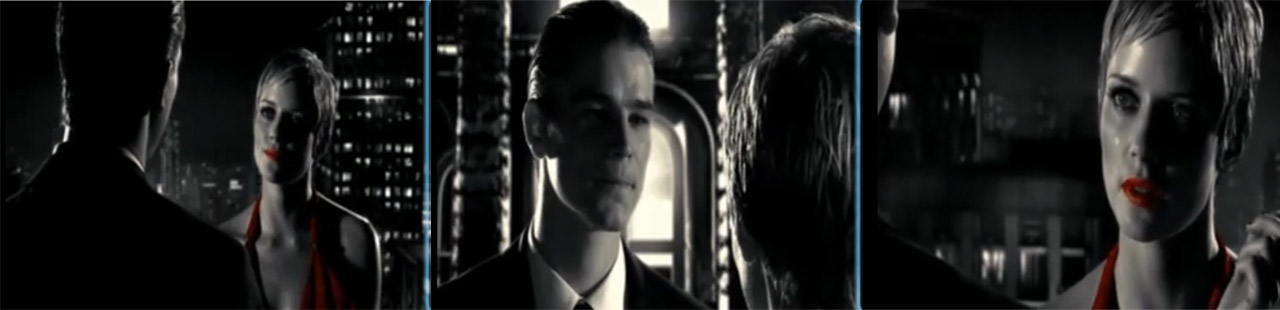
Here we can see the flipping between each character looking at one another this is to allow the viewer to experience the scene almost from the viewpoint of each character, to really see as they do.
Eyeline Match
An eyeline match is where the viewer is allowed to see what a character is seeing.

Graphic Match
This is a cut in film editing where the two shots or two objects are placed on the screen together to metaphorically link or bind them to one another.

Linking these two objects allows for the viewer to compare them and see the similarities almost creating a mental link between them.
Action Match
A film editing techniques where the editor cuts from one shot to another view that matches the first shot's action.
Jump cut
A cut in film editing where two sequential shots of the same subject are taken from slightly varying angles, giving the effect of a slight jump in time.
Crosscut
A cut that is used in films to establish action occuring at the same time in more than one location. The camera typically cuts between different scenes to suggest a sense of simultaneity.
Cutaway
A film editing cut that interrupts a continuously filmed action by inserting a view of something else. It is usually folowed by a cut back to the first shot .
Insert
A shot filmed from a different angle/focal length from the master shot. Inserts cover action already covered in the master shot, but emphasize a different aspect of that action due to the different framing.
Dissolve
An editing technique which involves a gradual transition from one image to another. The terms fade-in/out are used to describe a transition to and from a blank image.

Cut
In film editing, a cut is an abrupt, but usually trivial film transition from one sequence to another.
Fade-in, Fade-out
Synonymous with a dissolve transition. A fade-in/out involves dissolving from or too a flat colour screen (usually black, grey or white).
Wipe
A type of film editing transition where one shot replaces another by travelling from one side of the frame to another or with a special shape.

Superimposition
In film editing, this is the placement of an image or video on top of an existic image/video, usually to add to the overall image effect, or to conceal soomething.
Long take/short take
A long take is an interrupted shot that lasts much longer than the conventional editing pace either of the film or films in general.
A short take is the opposite, usually much shorter than the conventional take, lasting a few seconds at most.
Slow motion
An effect there time appears to be slowed down. Typically achieved by capturing frames at a rate that is higher than their playback.
Ellipsis & expansion of time
the narrative device of omitting a portion of the sequence of events, allowing the reader to fill in the narrative gaps. The vast majority of films use ellipses to clear actions that add nothing to the narrative.
Post production
Post-production, or postproduction, is part of the process of filmmaking. It is a term for all stages of production occurring after shooting or recording individual program segments.
Visual effects
In filmmaking, visual effects (abbreviated VFX) are the processes by which imagery is created and/or manipulated outside the context of a live shot.

No comments:
Post a Comment